China + Vietnam Dual-Origin Tissue Supply for Importers
Most tissue paper buyers do not switch suppliers because of a price difference of a few cents per case. They switch when a single-country supply chain becomes a business risk — a duty change, a port congestion event, a power restriction at the plant, or a capacity crunch in peak season.
Since 2018 we have run production in two countries under one quality system: Dongguan in China and Bac Ninh in Vietnam. This article explains what dual-origin supply means in operational terms, what to verify before you rely on it, and how to structure an order so it actually reduces risk instead of adding complexity.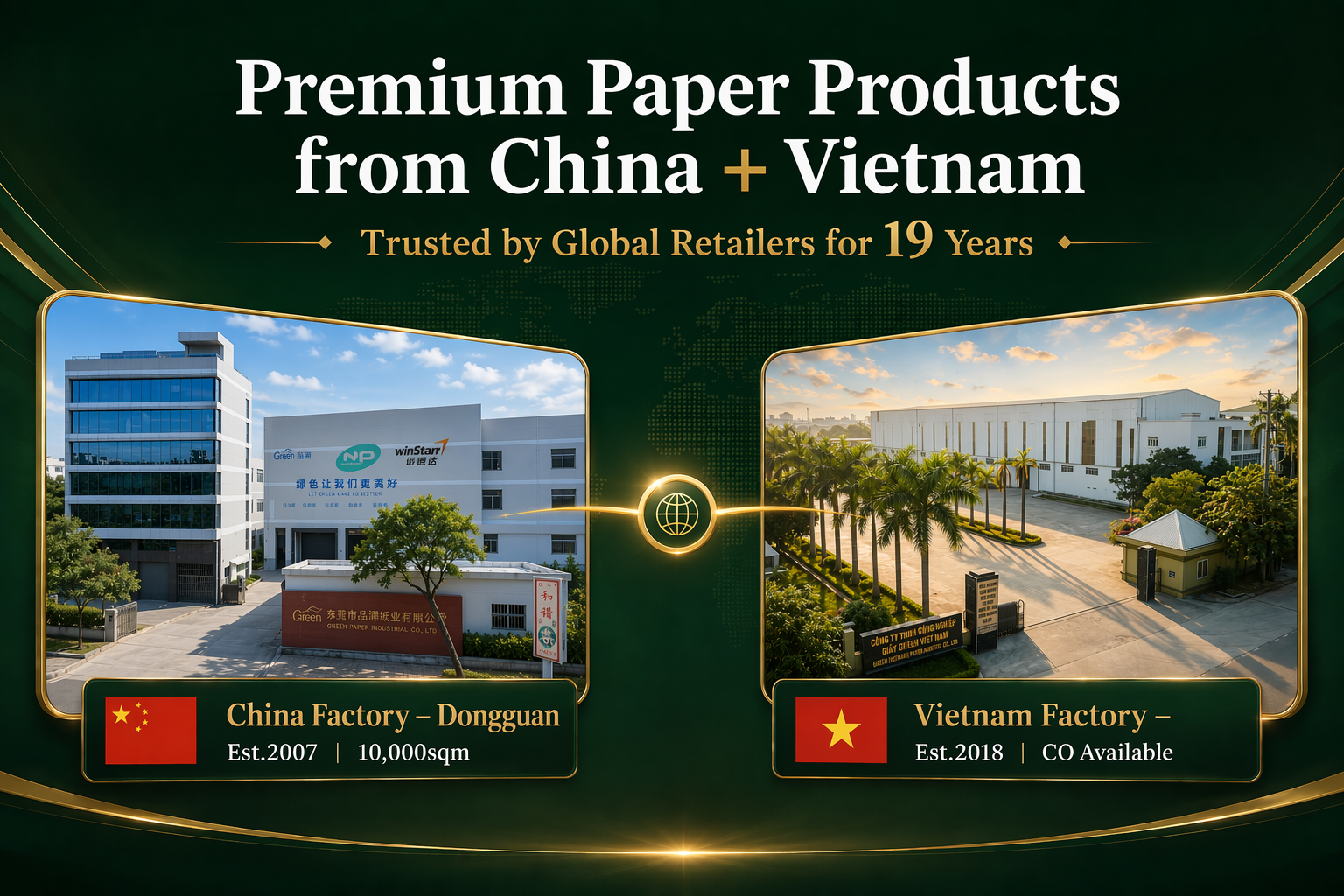
1. Why country of origin became a procurement question
Tissue paper is a high-volume, low-unit-value product. A 40HQ container of toilet tissue can carry tens of thousands of retail units, which means the duty and freight component of your landed cost is large enough that a change in trade treatment moves your retail margin, not just your paperwork.
Three pressures have pushed origin diversification from "nice to have" to a line item in sourcing reviews:
- Duty exposure. Successive rounds of trade measures on Chinese-origin goods have made the origin declaration a variable in landed-cost modelling rather than a fixed assumption.
- Capacity concentration. A single plant, or a single country, is exposed to power rationing, holiday shutdowns, and weather disruption. Peak-season retail programmes do not move their in-store dates.
- Retailer compliance. Large grocery and discount chains increasingly ask suppliers to document origin, chain of custody and business continuity planning as part of the vendor onboarding file.
Dual-origin supply is the practical answer to all three — but only if the second origin is genuinely under your supplier's own control.
2. What "dual-origin" means here — two plants, one quality system
| Plant | Location | Role |
|---|---|---|
| Dongguan Factory | Guangdong, China (headquarters) | Core production, OEM programme management, sampling |
| Green (Vietnam) Paper Industrial Co., Ltd | Bac Ninh, Vietnam (established 2018, 2 paper mills) | Alternative country of origin for tariff-sensitive destinations |
Company scale behind these two sites:
- 60+ processing machines
- 210,000 cases per month
- 10,000 m² Dongguan facility, approximately 100 staff
- Export operation running since 2007, parent company since 2001
The Vietnam plant is not a subcontractor and not a trading partner. It is a wholly owned subsidiary with the same management system, the same raw-material standards and the same QC procedures as the Chinese plants. That distinction matters: if your supplier brokers capacity at a third-party mill, you inherit a quality and liability gap you cannot audit.
3. Same specification, two origins — what to verify
Quality parity between origins is the first objection every experienced buyer raises, and it is the right question. Ask for these five items before you accept a Vietnam-origin quotation:
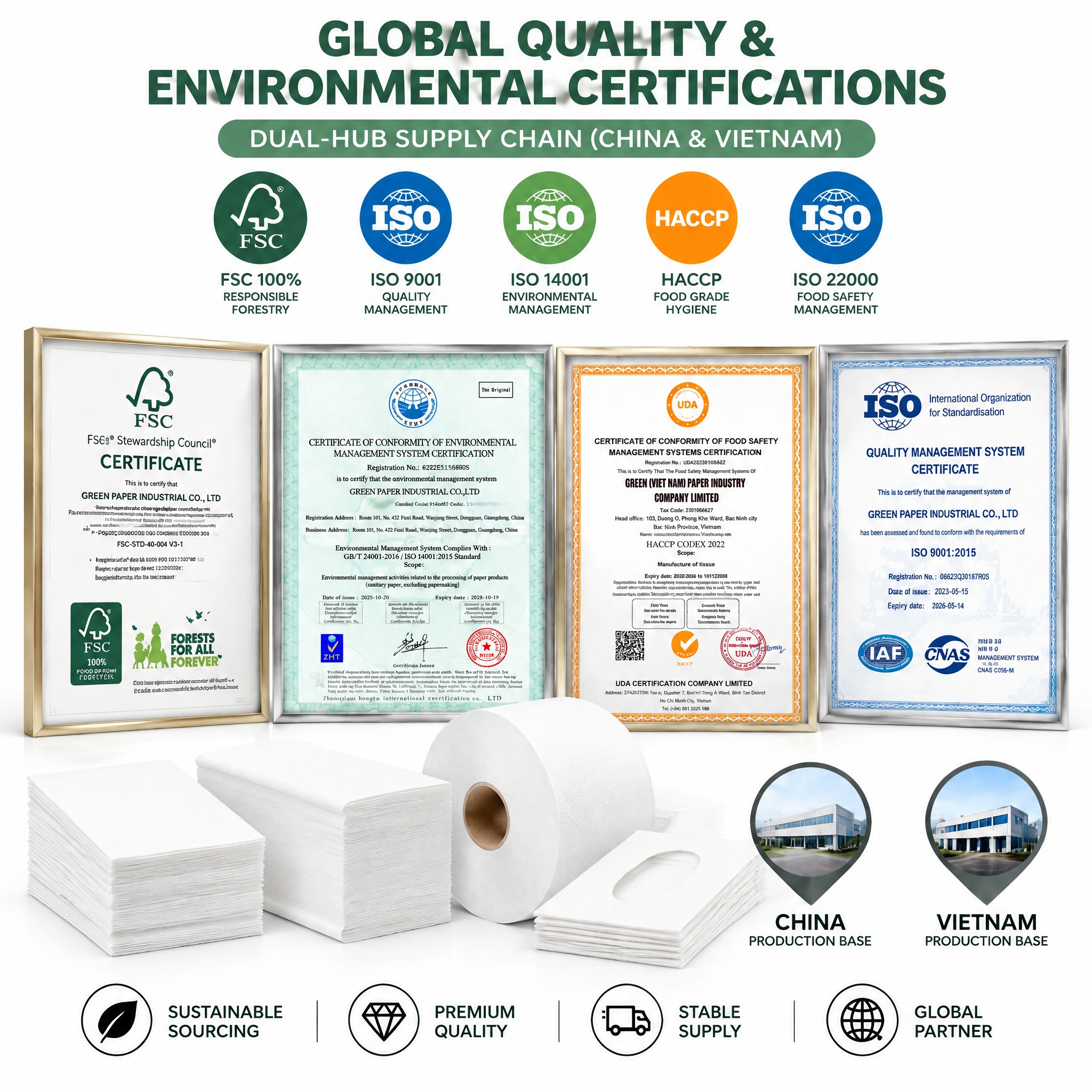
- Certificate scope, not just certificate presence. Confirm that ISO 9001 and ISO 22000 certificates list the Vietnamese legal entity and the product categories you are buying. A group-level certificate that names only the Chinese entity does not cover a Vietnam shipment.
- FSC chain-of-custody for that site. FSC certification is site-specific. If the EU retailer requires FSC, the Vietnamese mill must appear on the chain-of-custody documentation.
- One QC procedure document, two sites. Ask to see the inspection standard itself — grammage tolerance, ply bonding, wet strength, roll diameter, count per case, and the AQL sampling plan. If the document is the same for both sites, parity is a system, not a promise.
- Pre-shipment inspection. In-house QC on every batch, with third-party inspection (SGS, BV, Intertek) permitted at buyer's arrangement and cost.
- Declared defect target. Our internal target is below 0.5% for standard SKUs; the binding acceptance criteria should still be agreed per PO under an AQL standard.
4. The landed-cost comparison you should actually run
Buyers often compare FOB price per case and stop there. Origin decisions are made on landed cost, so build the comparison on these lines:
| Cost line | China origin | Vietnam origin | What to watch |
|---|---|---|---|
| Ex-works / FOB price | Baseline | Usually similar, confirm per SKU | Do not assume Vietnam is cheaper on price alone |
| Duty at destination | Depends on current trade measures | Depends on origin rules and destination | Confirm with your customs broker before quoting your own customer |
| Ocean freight | Shenzhen (Yantian), Guangzhou (Nansha) | Haiphong, Ho Chi Minh | Routing and transit time differ by destination |
| Inland haulage + port fees | Varies by plant | Varies by plant | Small at container level, not zero |
| Clearance and documentation | Standard | Standard, plus origin documentation | Make sure the origin file is complete before booking |
| Working capital | Deposit at PO | Deposit at PO | Same terms: 30% T/T deposit, 70% against B/L copy |
Two practical rules:
- Quote both origins on the same spec sheet. If the specs differ between quotes, the comparison is meaningless.
- Ask for the full landed cost, not the FOB delta. We quote FOB, CFR, CIF, DDU and DDP, so you can compare on a single delivered number instead of assembling five cost lines yourself.
5. Structuring a split order without creating chaos
Dual-origin supply fails when it is treated as two separate supply chains. The workable pattern looks like this:
- One PO structure, two origin lines. Keep a single commercial relationship and a single specification; let the origin be an attribute of each line item.
- Split by SKU stability. Put established, repeat-order SKUs on the origin with the strongest duty position; keep new OEM artwork in the plant where the sampling and plate-making already happened.
- Split by season, not by container. Peak-season volume should be pre-assigned to a plant so both sites are scheduled early instead of competing for the same slot.
- Agree the production split in writing at quotation stage. Our quotes state which plant produces which line; if capacity requires a change, it is confirmed with you before production, not after.
- Keep packaging identical. Same artwork, same barcode, same case pack across both origins — otherwise your DC receiving team will create a second SKU.
MOQ is 1 × 40HQ container, and 2–3 products can be combined in that container, so you can validate two origins and a shortlist of categories in one shipment instead of committing to a full programme.
6. Lead times and lanes, by origin
| Scenario | Reference lead time |
|---|---|
| Standard SKU, existing packaging | 25–30 days after PO and deposit |
| Full OEM, new artwork and plate-making | 35–45 days including artwork approval |
| Repeat order, same SKU | 20–25 days |
Loading ports: Yantian (Shenzhen), Nansha (Guangzhou) for China; Haiphong, Ho Chi Minh for Vietnam.
For North American buyers we also have a US entity, Winstarr Janitorial Supply Inc. (Texas, established 2016), which supports local invoicing and after-sales handling — useful when your finance team prefers a domestic counterparty for the service side of the contract.
7. Questions to put to any dual-origin supplier
Use this list as a filter. Suppliers who broker capacity will struggle with questions 1–3.
- Is the second-country plant owned, or is it a subcontractor?
- Can you send the ISO 9001 and ISO 22000 certificates that name that legal entity and those product categories?
- Is the FSC chain-of-custody valid for that site?
- Which SKUs are produced 100% in the second country, and which are split?
- What is the reference lead time from that origin, and which port do you load from?
- What happens to my order if the second-country plant is at capacity in peak season?
- Can you quote both origins on one spec sheet with a DDP delivered number?
8. Next step
Send us your destination postal code, target categories and annual volume. We will return a dual-origin comparison on one spec sheet — FOB and DDP — within 1–2 working days, plus the certificate pack for both entities.
Green Paper Industrial Co., Ltd — tissue paper manufacturing since 2007, two plants in China and Vietnam, 210,000 cases per month, ISO 9001 · ISO 14001 · HACCP CODEX · FSC.
FAQ
Is Vietnamese tissue paper the same quality as Chinese tissue paper?
It can be, if the same company runs both sites under one quality system. Ask for the QC standard document and confirm it is shared, and confirm certificate scope names the Vietnamese entity. Ours does: same ISO 9001 system, same raw-material standards, same inspection procedures.
Can you produce my entire order in Vietnam?
For many categories, yes — the Vietnam plant has independent production capacity with two paper mills. Some categories may split between countries based on capacity and lead time. We confirm the split at quotation stage, before you commit.
Doesn't a second origin add cost?
It can add documentation effort, not necessarily product cost. The trade-off is continuity: a second qualified site is what lets you keep a retail programme on schedule when one country's capacity or trade treatment changes.
Do you offer DDP to the US and EU?
Yes. We support FOB, CFR, CIF, DDU and DDP. Send the destination postal code, product mix and total quantity and we return a landed-cost quote within 1–2 working days.
What is the MOQ for a first order testing two origins?
1 × 40HQ container combining 2–3 products. Many buyers use the first container to test their priority categories in one shipment before committing to a programme.
Do you have overseas warehouses or dropshipping?
No. Our model is container-level B2B export to importers, distributors, HORECA and janitorial supply channels. We state that plainly because a supplier that claims to do everything usually does the core thing less well.