FSC Tissue Paper in 2026: EUDR and Green Claims Rules
FSC certification in tissue paper verifies the chain of custody of wood fibre — that certified material entering a converting plant is tracked, segregated and passed through to the finished case — not that the forest itself is well managed, and not that the product is biodegradable, low-carbon or chemical-free. For European buyers, two regulatory dates in 2026 have turned that distinction from a technicality into a purchasing question: the EU's Empowering Consumers Directive has applied since 27 September 2026, and the EU Deforestation Regulation's substantive obligations apply from 30 December 2026 for large and medium operators.
That is the whole argument in one paragraph. The rest of this page explains what each piece means at the level of a purchase order, and what a tissue supplier can and cannot put in writing.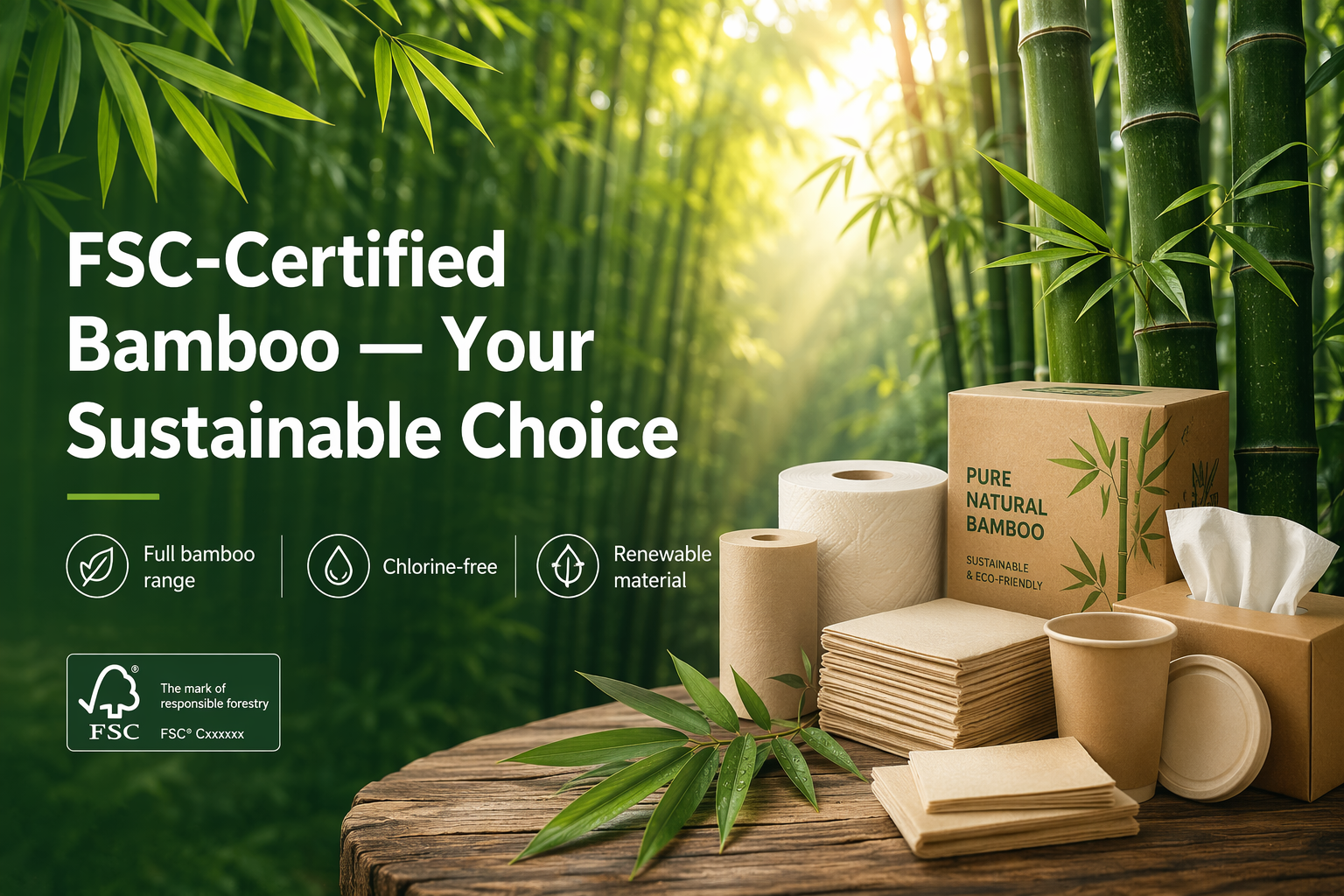
Why 2026 is the year tissue buyers started asking
Tissue is a wood-fibre product. Even when the finished article is a napkin or a hand towel, the raw material is parent reel made from pulp, and pulp comes from trees. That single fact connects three separate rules that used to sit in different departments:
- Green claims. Since 27 September 2026, the EU's Empowering Consumers Directive (ECGT) prohibits generic environmental claims and offset-based "climate neutral" product claims. "Eco-friendly tissue" is no longer a weak headline — it is an unsubstantiated claim.
- Deforestation due diligence. EUDR's substantive obligations apply from 30 December 2026 for large and medium operators, with a later date for micro and small enterprises. Whether a specific tissue SKU falls inside the regulation's product annex depends on its customs classification — confirm that with your importer or customs broker rather than with a supplier — but the commercial effect is already visible: buyers are requesting pulp-origin documentation before they release a purchase order.
- Certification. FSC is the mechanism most tissue supply chains use to evidence fibre sourcing. It is also the most commonly misunderstood.
None of these are marketing exercises. Each one requires a document that either exists or does not.
What FSC certification actually verifies
FSC operates two distinct types of certificate, and buyers routinely conflate them:
| Certificate type | What it covers | Who typically holds it |
|---|---|---|
| FM — Forest Management | How a specific forest is managed: environmental, social and economic criteria | Forest owners and managers |
| COC — Chain of Custody | The tracking of certified material from forest through pulp mill, paper mill, converter and trader to the finished product | Converters, printers, traders, brand owners |
A tissue converting plant holds COC, not FM. That is normal and correct — the plant does not own forests. COC is what allows a converter to sell a product carrying an FSC label, because it proves the certified input was segregated or credit-balanced through the process and that the output claim matches the input volume.
What COC does not verify: that the product biodegrades faster, that it contains no process chemicals, that its carbon footprint is lower, or that workers in the supply chain were audited to a social standard. Those are separate schemes — and if a supplier implies COC covers them, that is a warning sign, not a selling point.
The three FSC labels, and why the difference matters commercially
| Label | What it means on the pack | Practical implication for a buyer |
|---|---|---|
| FSC 100% | All fibre is from FSC-certified forests | Highest assurance, narrowest availability, usually the highest cost |
| FSC Mix | A mix of FSC-certified, recycled and/or controlled wood, with a defined minimum threshold | The most common label in tissue converting; widely available across retail and AFH formats |
| FSC Recycled | All fibre is recycled, with a defined proportion of post-consumer material | Relevant to recycled-pulp programmes; verify the post-consumer percentage rather than assuming it |
For private label, the label choice is a design and compliance decision that must be made before artwork approval — the label, the licence code and the claim wording all appear on pack, and retrofitting them after plates are cut is expensive.
What to request from a tissue supplier
Five documents, in this order. A supplier who cannot produce the first two should not be shortlisted.
| # | Document | What you are checking |
|---|---|---|
| 1 | FSC certificate, full PDF (not a logo, not a screenshot) | Certificate holder name matches the entity you are contracting, and validity date has not lapsed |
| 2 | FSC scope document | The specific site and product categories covered. A group certificate that excludes the plant running your order is a common and costly surprise |
| 3 | FSC licence code (format FSC-C######) | Searchable in the public FSC certificate database — verify it yourself, it takes under a minute |
| 4 | Label approval / trademark licence confirmation | Confirms which of the three labels your SKU may carry |
| 5 | Pulp origin and species declaration | The document that supports due-diligence obligations; ask for it per order, not once per year |
The second item is the one buyers skip most often, and it is the one that causes failures at retail vendor onboarding.
Fibre options and what changes in the specification
Three fibre routes are available in our range — virgin, recycled and bamboo — and each one changes the specification, not just the story. These are the variables to test on sample rather than to assume:
| Fibre | What typically changes | What to verify on sample |
|---|---|---|
| Virgin (wood pulp) | Baseline for brightness, wet strength and softness | Sheet formation, wet tensile after 3 seconds immersion |
| Recycled | Brightness and strength usually require compensation through GSM or refining | Actual measured GSM vs nominal, wet strength, visible specks under retail lighting |
| Bamboo | Different fibre morphology from softwood/hardwood blends | Tensile and softness against your virgin reference, plus label claim eligibility |
| TAD (through-air-dried) | Bulk and absorbency rather than fibre source | Roll diameter and case cube, since bulk changes packing density |
The commercial point: fibre choice is a specification decision with a cost and a test consequence, not a values statement. Buying "sustainable tissue" without agreeing GSM, ply and wet-strength acceptance criteria produces a shipment that satisfies nobody.
What we hold, and what we will not claim
We hold FSC certification at company level — alongside ISO 9001, ISO 22000 and HACCP CODEX. Our material options include virgin, recycled, mixed and bamboo pulp across toilet tissue, facial tissue, paper napkins, hand paper towels, kitchen towels and toilet seat covers.
What we will not write, and would advise any buyer to distrust from another supplier:
- "Carbon neutral" or "climate neutral" — no verified offset or footprint accounting sits behind it, and offset-based product claims are precisely what ECGT targets.
- "Biodegradable" or "plastic-free" without a test report and a definition of the test method.
- "Eco-friendly", "green", "sustainable tissue" as standalone descriptors — generic claims are now a compliance exposure in the EU, not a differentiator.
- Social audit claims we cannot evidence. We do not hold BSCI, SEDEX or BRC, and we will not imply otherwise to win a vendor code.
- A group-level certificate presented as site-level coverage. Ask for the scope document.
We state the boundary because the alternative — a supplier who claims everything — gives a buyer no way to tell which claims survived scrutiny.
Next step
If you are preparing a European listing and need the certificate scope document, the licence code and a pulp-origin declaration for your SKU, send the target specification and destination market — we will return the documents and confirm which plant and fibre route fits. See certifications (/certifications) or go to contact (/contact).
FAQ
Does FSC certification mean the tissue is biodegradable?
No. FSC certifies the chain of custody of wood fibre. Biodegradability is a separate property that requires its own test method and report. Tissue paper is generally dispersible in water, but that is a material property, not an FSC claim.
What is the difference between FSC FM and FSC COC?
FM (Forest Management) certifies how a forest is managed and is held by forest owners. COC (Chain of Custody) certifies that certified material is tracked through processing to the finished product, and is what a tissue converter holds.
How do I verify a supplier's FSC certificate?
Search the licence code — format FSC-C###### — in the public FSC certificate database, then compare the certificate holder name, site address and product category against the entity you are contracting.
Does EUDR apply to tissue paper?
EUDR's substantive obligations apply from 30 December 2026 for large and medium operators, with a later date for micro and small enterprises. Whether a specific tissue SKU falls inside the regulation's product annex depends on its customs classification, so confirm scope with your importer or customs broker. Regardless of classification, expect buyers to request pulp-origin documentation as standard practice.
Can you supply FSC-labelled private label?
Yes — label type (FSC 100%, FSC Mix or FSC Recycled) is agreed before artwork approval, because the label and licence code are printed on pack. Minimum order is 1 × 40HQ, which can combine 2–3 products.
Which fibre should I choose for a European retail programme?
It depends on the label claim you intend to print and the price position. Recycled and FSC Mix are the most common combinations in European private label; the decision should be made with the label requirement in hand, not after the specification is fixed.