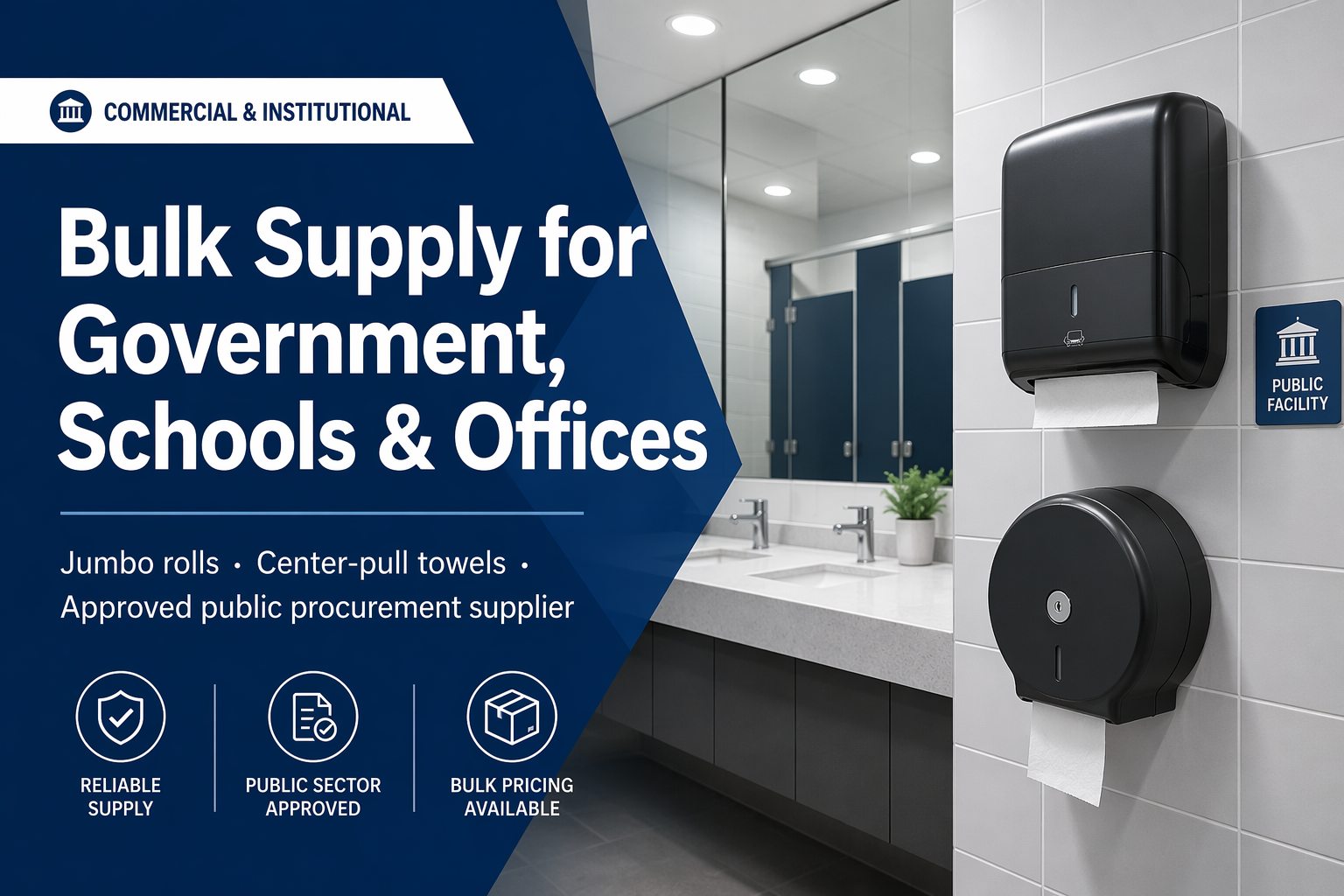
Multifold vs C-fold vs Centrepull Hand Towels for AFH
Away-from-home (AFH) hand towel is a category where the product is only half the decision. The other half is the dispensing system already bolted to the wall in your customer's washrooms — and a distributor who ignores that ends up with stock that does not fit a single dispenser in the territory.
This guide compares the four systems we manufacture, on the criteria that decide a distributor's range: dispenser fit, cost per use, refill labour, storage cube and the washroom segments each one suits.
1. The four systems, in one table
| System | Format | Typical use per dry | Refill labour | Best-fit washroom |
|---|---|---|---|---|
| Multifold | Interfolded stack, single-sheet dispensing | One or two sheets | Low — stack refill, no separating | Offices, healthcare, education, high-traffic commercial |
| C-fold | Folded stack, interlocked | Two sheets often dispensed together | Low to medium | Older dispenser estates, budget-sensitive sites |
| N-fold | Interfolded, slimmer folded profile | One sheet | Low | Modern slim dispensers, space-constrained washrooms |
| Centrepull | Roll with centre-feed, sheet pulled from the middle | One sheet | Very low — roll change, high capacity | Airports, shopping centres, stadiums, industrial sites |
The practical selection logic is: match the dispenser estate first, then optimise cost per use within it. Retrofitting dispensers across a customer's sites costs more than any per-case saving.
2. Multifold: the default for high-traffic commercial
Multifold towels are interfolded so that pulling one sheet presents the next. That single-sheet presentation is why multifold dominates offices, healthcare and education: it controls consumption without the user having to separate plies, and it refills quickly from a stack.
Range planning points:
- Open size and folded size must match the dispenser's internal dimensions. A folded-height difference of a few millimetres is enough to jam a dispenser.
- Count per pack drives how often a washroom is serviced. Higher pack counts reduce refill frequency but increase storage footprint per site.
- Ply and grammage determine hand-dry performance. A low-grammage multifold that tears on the first pull costs more in complaints than it saves per case.
This is the category where a small specification discipline pays off most: lock open size, folded size, fold type, count per pack and pack per case, and the range becomes predictable across a whole territory.
3. C-fold: installed base, budget segment
C-fold is the older interlocked format. It is still present in large installed estates, particularly in cost-driven commercial and industrial sites, because the dispensers are cheap and the towels are familiar.
Commercially, C-fold is a defend-the-account line rather than a growth line: if a customer's estate is C-fold, keep supplying it and use the relationship to introduce multifold or centrepull at the next refit. Two operational notes:
- Interlocked stacks can dispense two sheets at once, which raises consumption. Consumption data, not case price, is the right metric when comparing against multifold.
- Because the format is older, spec drift between suppliers is common. Compare open size, folded size and count per pack, not just case price.
4. N-fold: the slim-profile option
N-fold uses a slimmer folded profile than C-fold, which suits modern compact dispensers and washrooms where wall space is limited. It dispenses one sheet at a time, so consumption behaves closer to multifold than to C-fold.
Where it wins: refurbished washrooms, small-format retail, and sites where the dispenser specification has already been standardised on a slim profile. Where it loses: territories with a large legacy C-fold or multifold estate, because it adds a fifth SKU without replacing an existing one.
5. Centrepull: lowest refill labour, highest capacity
A centrepull roll feeds from the centre, so the roll lasts far longer between refills than a stack of folded towels. That is the whole value proposition: labour, not paper, is the dominant cost in high-traffic washrooms.
For distributors selling into airports, shopping centres, stadiums and industrial facilities, centrepull is usually the line that wins the contract, because the facilities manager is buying reduced servicing frequency. Key specification fields:
- Roll width and roll diameter
- Core diameter and centre-feed geometry
- Sheet count per roll
- Dispenser compatibility — the geometry is proprietary across dispenser brands
- Case cube, since rolls are bulky relative to their sheet count
For high-traffic AFH sites we also supply jumbo roll tissue on the same logic: fewer roll changes, less servicing time, fewer stockouts at peak.
6. The comparison distributors should actually run
Cost per case is the wrong metric because systems do not deliver the same number of hand dries per case, and servicing labour differs by format. Build the model like this:
| Line | Multifold | C-fold | N-fold | Centrepull |
|---|---|---|---|---|
| Sheets per pack / roll | ||||
| Packs per case | ||||
| Sheets per case | ||||
| Sheets used per dry (measured) | ||||
| Hand dries per case | ||||
| Case cost | ||||
| Cost per 1,000 dries | ||||
| Refills per 1,000 dries | ||||
| Labour minutes per refill | ||||
| Servicing cost per 1,000 dries |
Two lines carry the decision: cost per 1,000 dries, and servicing cost per 1,000 dries. In low-traffic offices the paper cost dominates; in high-traffic transport hubs the labour cost does, which is exactly why the same distributor needs both multifold and centrepull in range.
7. Building the AFH range: a container-level view
Our MOQ is 1 × 40HQ container, and 2–3 products can be combined in it — which suits a distributor building a first AFH range rather than committing to a single line.
A workable first container for a janitorial distributor:
- 1–2 hand towel formats (multifold or centrepull, depending on the local dispenser estate)
- 1 jumbo roll tissue or standard toilet tissue line
- 1 facial tissue or napkin line for the office and HORECA crossover
- 1 toilet seat cover line if hotel or transport sites are in the territory
That mix tests four categories with one shipment, one set of documents and one origin decision. If your territory includes North American customers with duty exposure, the same mix can be produced at our Vietnam plant and quoted as a second origin on the same specification.
Lead times: 25–30 days for standard SKUs with existing packaging, 35–45 days for full OEM with new artwork and plates, 20–25 days for repeat orders.
8. Category notes for combined washroom supply
Because AFH buyers usually supply the whole washroom, not one product, range coherence matters more than depth in a single SKU:
- Toilet tissue — standard roll, jumbo roll, and centrepull formats; 1-ply for AFH consumption economics, 2-ply for premium sites.
- Facial tissue — box, soft pack and cube pack for hotel rooms, offices and reception areas.
- Napkins — dinner, cocktail, luncheon and dispenser formats for HORECA; ISO 22000 and HACCP CODEX apply where food contact is expected.
- Kitchen towel — household and commercial rolls; wet strength is a stated specification, not a marketing claim.
- Toilet seat cover — 1/2 fold and 1/4 fold for airports, hotels and public facilities.
Supplying all six categories in one container is the operational advantage of a single-source programme: one set of documents, one origin decision, one quality standard.
9. Plan the range with your dispenser estate in hand
Send us your dispenser models or photographs, your territory's key accounts and your target container mix. We will return a matched specification set for the formats that fit your installed base, plus a landed-cost quote on your destination postal code — FOB or DDP.
Green Paper Industrial Co., Ltd — AFH and retail tissue supply across six categories. Two plants in China and Vietnam, 60+ machines, 210,000 cases/month, ISO 9001 · HACCP CODEX · FSC.
FAQ
What is the difference between multifold and C-fold hand towels?
Both are folded stacks, but multifold is interfolded to present one sheet at a time, while C-fold is interlocked and often dispenses two sheets together. Multifold controls consumption better; C-fold serves the large legacy dispenser estate.
What is a centrepull hand towel?
A roll that feeds from the centre, so the user pulls a sheet from the middle of the roll. It offers the highest capacity per refill, which is why it suits airports, shopping centres and other high-traffic sites where servicing labour dominates cost.
How many hand towels are in a case?
It depends on the format, folded size and pack configuration — there is no universal case pack. The comparable number is sheets per case and hand dries per case, which is why we quote on a full specification rather than "a case of hand towels".
Which system is cheapest?
Lowest cost per case and lowest cost per dry are different answers. In low-traffic offices multifold usually wins on paper cost; in high-traffic transport sites centrepull wins on servicing labour. Model cost per 1,000 dries and servicing cost separately.
Do you supply dispensers?
Our range is paper, not hardware. We match product specification to your existing dispenser estate — send the dispenser model or a photo and the folded dimensions, and we will confirm fit before sampling.
Can you mix hand towels with tissue and napkins in one order?
Yes. MOQ is 1 × 40HQ combining 2–3 products, so a first order can cover two or three categories in one container.
What is the lead time for a distributor's first order?
25–30 days after PO and deposit for standard SKUs with existing packaging; 35–45 days for full OEM with new artwork. Repeat orders run 20–25 days.